Our Curriculum
Our Montessori Curriculum
A rich academic education that begins with wonder, develops through experience and grows with the child.
At Porirua Montessori, we believe education should help children understand not only what they are learning, but how the world fits together and the part they can play within it.
Our curriculum is grounded in more than a century of Montessori educational practice and an understanding of the developmental needs of children.
We teach literacy, mathematics, science, history, geography, the arts and practical life through carefully prepared lessons, specialised materials, storytelling, research and meaningful work.
Our goal is not simply that children remember information. We want them to understand, make connections, question, discover and contribute.
Discover Cosmic Education Compare with the NZ Curriculum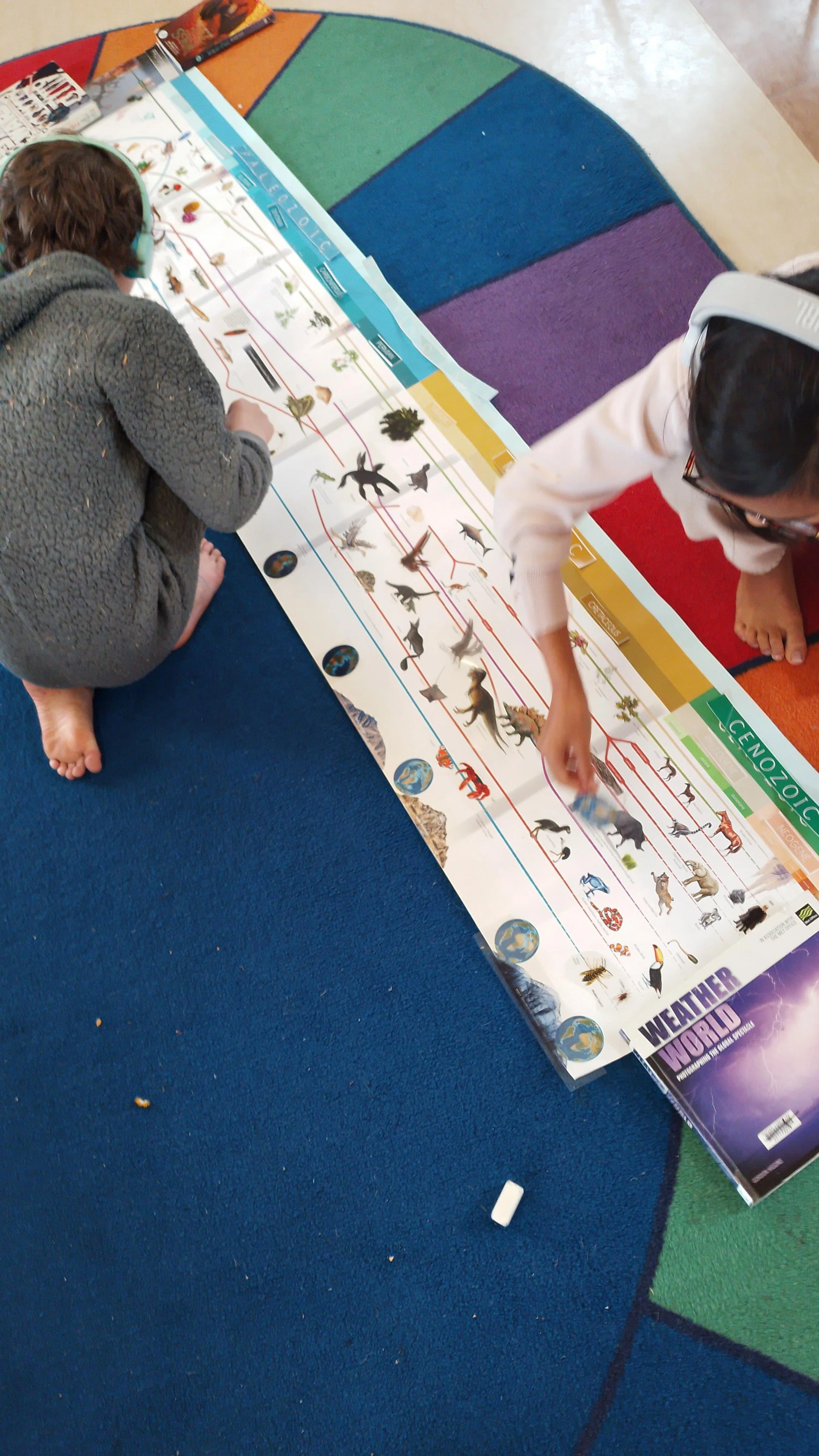
Our school is small. Montessori is not.
Dr Maria Montessori was an Italian physician, educator and advocate for children's rights. She opened her first Children's House in Rome in 1907.
Her educational approach developed through observation of children, work in education and medicine, and an interest in how people develop independence, knowledge and understanding.
Montessori education has continued to develop and be practised internationally for more than a century.
Children across generations have experienced Montessori education in many different countries, cultures and communities.
Montessori is a long-established educational philosophy, not a new experiment or a collection of classroom trends.
Our responsibility at Porirua Montessori is to practise that philosophy thoughtfully, faithfully and in a way that respects the children and whānau of Aotearoa.
Worldwide figures are estimates published by Montessori Aotearoa New Zealand .
Cosmic Education: understanding how everything connects.
Cosmic Education is the whole study of the history of the universe, life, humanity and our place within it.
Through Cosmic Education, children investigate how the universe came to be, how Earth formed, how life developed, how humans emerged and how civilisations have grown.
Woven throughout are geography, history, zoology, botany, earth sciences, mathematics, language, the arts and the practical work of human communities.
The curriculum gives children a bigger picture. They begin to see that discoveries in one area of learning connect with many others.
We explore the origins of the universe, Earth, life, humanity, language, mathematics and civilisation.
We consider the relationships between living things, human communities, cultures, the natural world and the responsibilities we have towards others.
For us, Cosmic Education is also about love and service. Children learn that they are connected to the wider world and that their actions matter.
We value scientific understanding and evidence, while also making space for children to encounter the creation stories, beliefs, worldviews and cultural traditions of different peoples.
The aim is to develop knowledge, imagination, empathy and a sense of responsibility.
The Great Stories: where learning begins.
At the heart of Montessori primary education are the Five Great Lessons, sometimes called the Great Stories.
We use storytelling because the primary-aged child has a powerful imagination and wants to understand the reasons behind things.
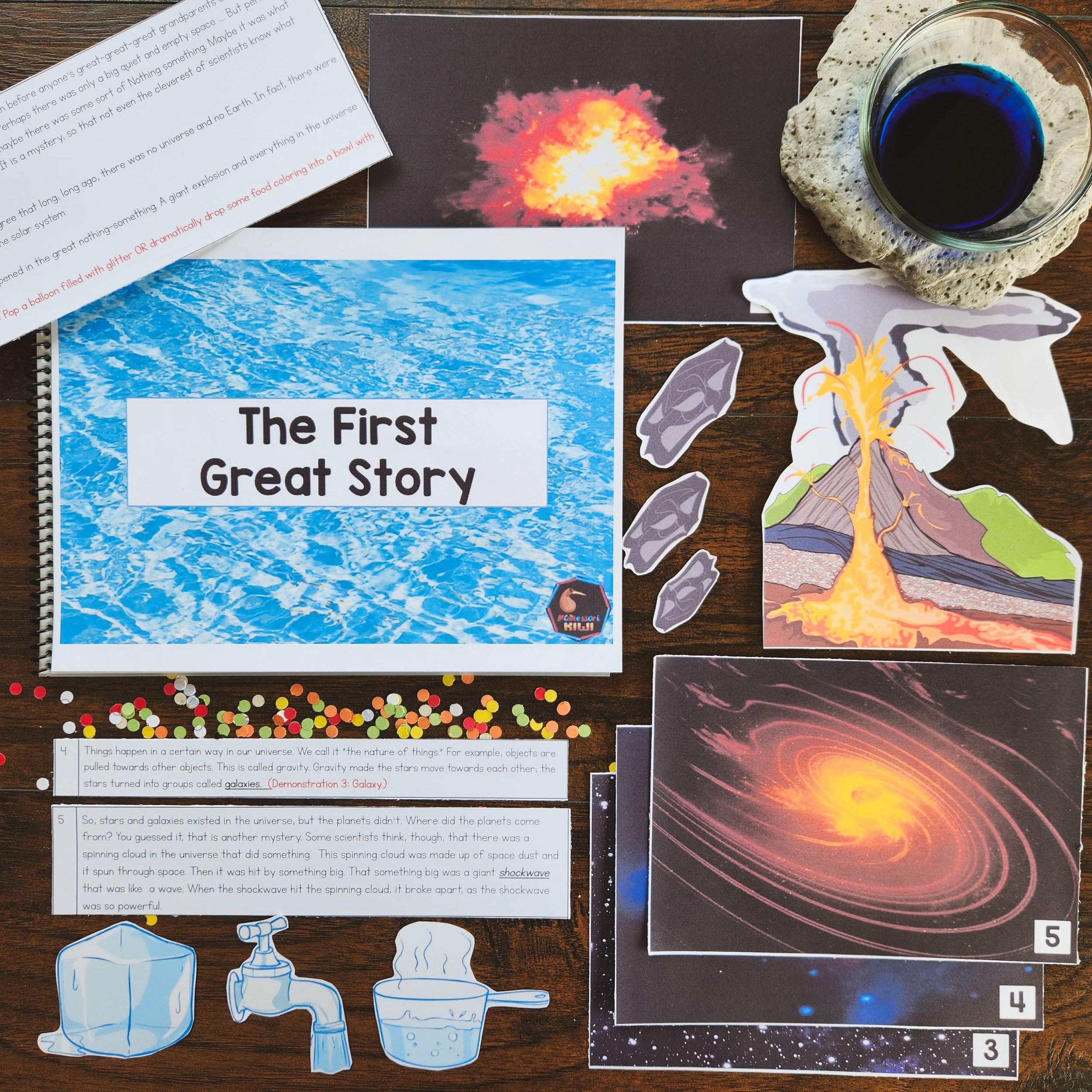
A Great Story introduces a big idea through vivid language, demonstrations and carefully chosen materials.
The story is a beginning, not the end of the learning.
Children then explore the questions it raises through lessons, experiments, reading, mathematics, research, writing, discussion and art.
The stories are revisited as children develop. Each time, they bring more knowledge, stronger reasoning and a greater capacity for understanding complex connections.
Imagination opens the door. Knowledge, effort and investigation take the learning further.
One story can open many areas of learning.
Imagine a child listening to a Great Story about the beginning of the universe and the formation of Earth.
The story invites curiosity. The teacher then guides children into real academic work.
Investigating solids, liquids, gases, gravity, energy, rocks, volcanoes and Earth's formation.
Exploring continents, landforms, oceans, maps and the changing surface of the Earth.
Using measurement, scale, time, large numbers and calculation to investigate scientific questions.
Reading information texts, developing vocabulary, taking notes, writing explanations and presenting findings.
Understanding chronological time, timelines, discoveries and the development of human knowledge.
Drawing diagrams, constructing models and representing new understanding through creative work.
A younger child may make a model, practise new vocabulary and record observations. An older child may research geological change, compare evidence, use measurements and write an extended explanation.
Both children are exploring the same great story, but at different depths and with different academic expectations.
This is how Montessori learning returns to important ideas and builds upon itself.
How does Montessori differ from the New Zealand Curriculum?
Both approaches value academic learning. The important difference is how learning is organised, introduced, revisited and experienced by children.
| Area | Refreshed NZ Curriculum | Porirua Montessori |
|---|---|---|
| Starting point | Nationally specified knowledge and skills, organised into learning areas with progression expectations across years and phases. | Montessori's developmental understanding of the child, Cosmic Education, individual lessons and a prepared environment. |
| How subjects connect | Learning areas identify subject knowledge and progression. Schools may also make connections through integrated teaching. | Subjects are deliberately woven together through the Great Stories, research and the interconnected study of the world. |
| How ideas return | Knowledge is sequenced and revisited through planned progression across year levels. | Children return to the Great Stories and connected ideas repeatedly, exploring them at increasing depth as their reasoning, imagination and knowledge develop. |
| Teaching | Explicit teaching of curriculum content, using approaches selected by the school and teachers. | Explicit individual and small-group lessons, followed by hands-on work, practice, investigation and increasing independence. |
| Daily rhythm | Often organised around timetable periods, subject lessons and year-level groups, although practices vary by school. | Long, purposeful work periods allow children to concentrate, receive lessons, practise skills and undertake extended investigations. |
| Individual progress | National learning expectations establish common reference points for progression. | Teachers observe individual development, introduce appropriate lessons and set personal academic goals, while ensuring meaningful progress across the curriculum. |
| Learning materials | Resources and materials vary according to the school and teaching approach. | Purpose-designed Montessori materials help children move from concrete experience towards abstract understanding. |
| Wider purpose | Equips learners with knowledge, skills and capabilities for life in Aotearoa and beyond. | Develops knowledge and skills alongside independence, responsibility, contribution, empathy and education for peace. |
Our curriculum has a different organising philosophy.
The refreshed NZ Curriculum sets out nationally defined learning expectations.
Our Montessori curriculum begins with the developmental needs of the child and an interconnected understanding of the universe, life and humanity.
We do not see learning as simply moving through separate lists of content. We want children to understand the relationships between ideas, revisit them, test them and build increasingly sophisticated knowledge.
We also recognise the importance of strong foundations in reading, writing and mathematics. Montessori children need both breadth of understanding and mastery of essential academic skills.
The result is a different daily educational experience, not an absence of structure or academic expectations.
For details of the New Zealand Curriculum and its implementation, see the Ministry of Education's Years 0–10 curriculum information . Curriculum content and requirements are being implemented in stages.
What do children actually learn?
Our interconnected approach includes deliberate teaching and practice in essential academic disciplines.
Montessori learning develops from concrete experience towards increasingly abstract, independent thinking.
Language and Literacy
Reading, spelling, vocabulary, grammar, handwriting, composition, research, oral language, literature and written communication.
Children learn the skills they need to read and write confidently, then use those skills to explore the wider curriculum.
Mathematics
Number, place value, operations, fractions, decimals, geometry, measurement, patterns, problem-solving and mathematical reasoning.
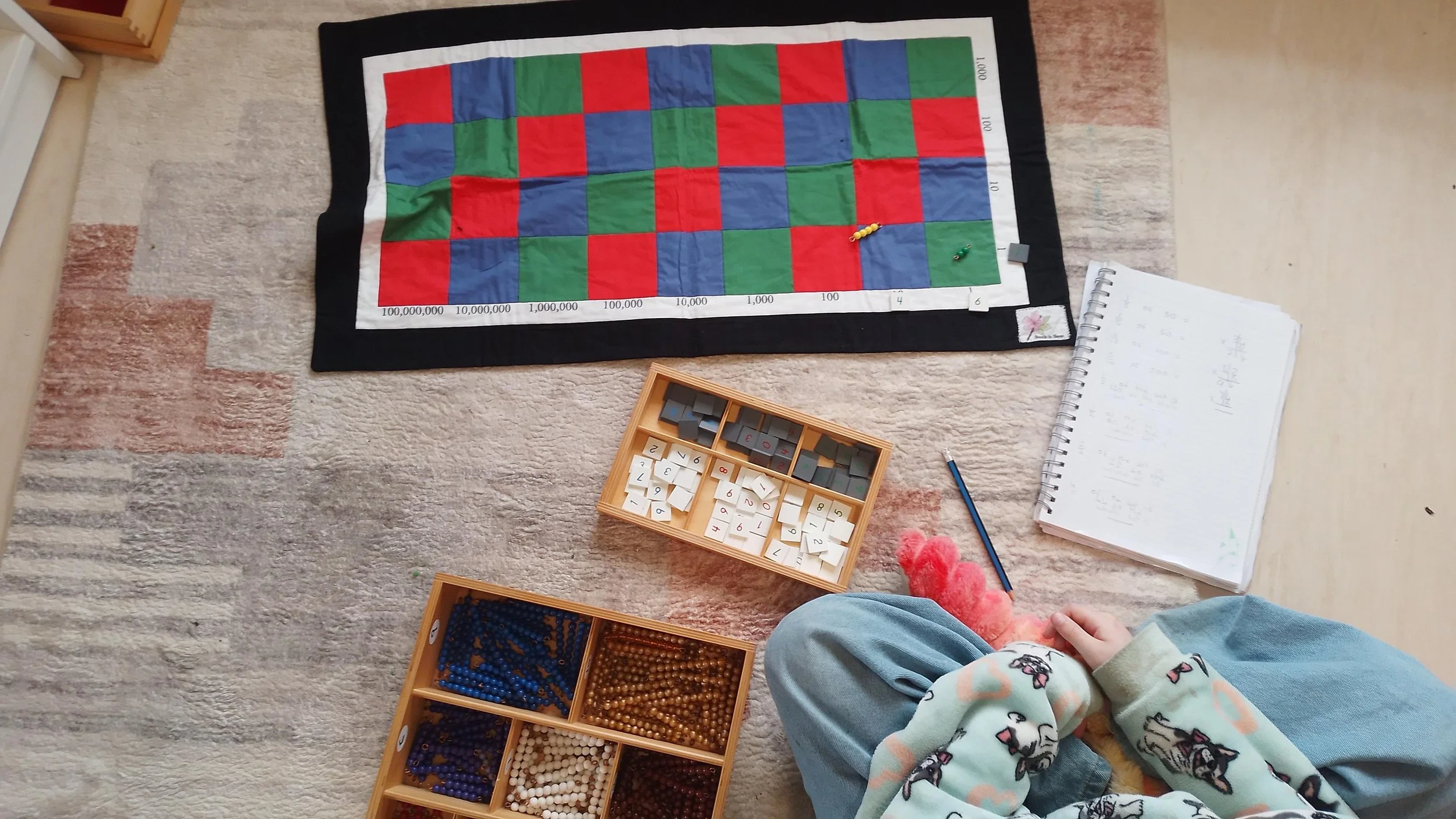
Specialised materials allow children to see, touch and understand mathematical relationships before working increasingly in the abstract.
Biology and Botany
Plants, animals, habitats, ecosystems, classification, adaptations, life cycles, living systems and the relationships between organisms.
Children observe, investigate, classify, research and connect living things to their environments.
Physics and Chemistry
Matter, forces, energy, changes in materials, simple investigations, observations, scientific reasoning and the physical world.
Demonstrations and experiments support curiosity while developing scientific knowledge and understanding.
Geography and Earth Sciences
Maps, continents, landforms, climate, weather, oceans, biomes, Earth's systems and human relationships with the environment.
Montessori materials make geography concrete while Cosmic Education reveals wider connections.
History and Civilisation
Time, chronology, human development, early civilisations, migration, inventions, technology, cultures and the changing relationships between people and places.
Timelines and storytelling help children place human history within the much larger story of life on Earth.
Arts, Music and Movement
Visual expression, creative processes, music, rhythm, coordination, movement and opportunities to communicate ideas in different ways.
These experiences support creativity, observation, self-expression and developing physical skills.
Practical Life, Peace and Community
Caring for materials, organising work, maintaining the environment, preparing for independence, respectful communication, cooperation and social responsibility.
Children learn that contributing to their community is part of their education.
What might learning look like on an ordinary morning?
One child may be having an individual mathematics lesson. Another may be practising spelling or working with fractions independently.
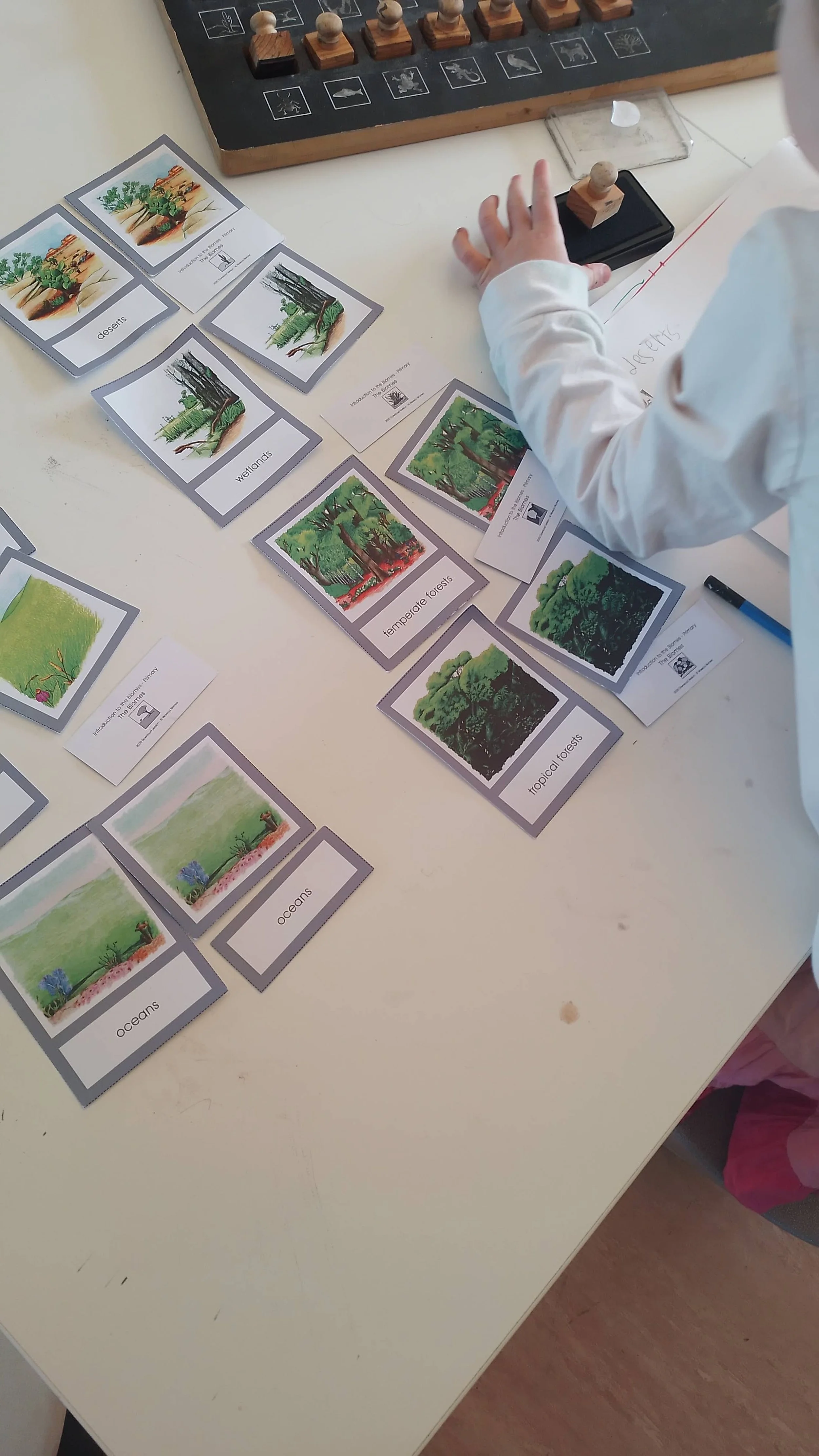
A group might be researching a biome, preparing a presentation or investigating a scientific question.
Another child may be revisiting a Montessori material they were introduced to earlier, working towards greater mastery.
This does not mean children are left to teach themselves.
The teacher is observing, guiding, introducing new lessons, monitoring academic progress and helping children develop independence.
Children are encouraged to make meaningful choices about work they have been introduced to, sustain concentration, meet expectations and care for the environment.
Freedom and responsibility grow together.
Individual learning does not mean uncertain expectations.
We value academic knowledge, meaningful effort and the development of genuine skills.
Lessons and goals
Teachers observe children carefully, introduce lessons appropriate to their development and guide them towards individual learning goals.
Practice and mastery
Children return to important skills through meaningful practice and increasing challenge. Learning takes time, effort and persistence.
Knowledge and independence
We want children to understand concepts deeply and gradually become more capable of using what they know independently.
We value effort and respect struggle.
Children learn through trying, practising, making mistakes, asking questions, receiving guidance and trying again.
A child may take longer to understand a concept. Another may be ready for further challenge.
Our role is to understand where each child is, provide appropriate teaching and help them move forward.
We do not rely on grades, certificates, points or prizes as the main reason for children to work.
We want children to experience the satisfaction of real achievement and discover that knowledge, character and skill develop through effort.
A worldwide philosophy, grounded in our own community.
Cosmic Education teaches children that humanity is interconnected, but it also asks us to understand the communities and places in which we live.
Our Montessori learning environment reflects Aotearoa New Zealand and the experiences of our tamariki and whānau.
We value Māori, Pasifika and other cultural perspectives, respect Te Tiriti o Waitangi and encourage children to learn about different ways people understand the world.
Children encounter different cultures, religions, philosophies and histories with curiosity and respect.
We also teach children the skills of cooperation, empathy, relationship-building and peaceful problem-solving.
Our aim is to help children see themselves as thoughtful, capable people who can contribute to Aotearoa and the wider world.
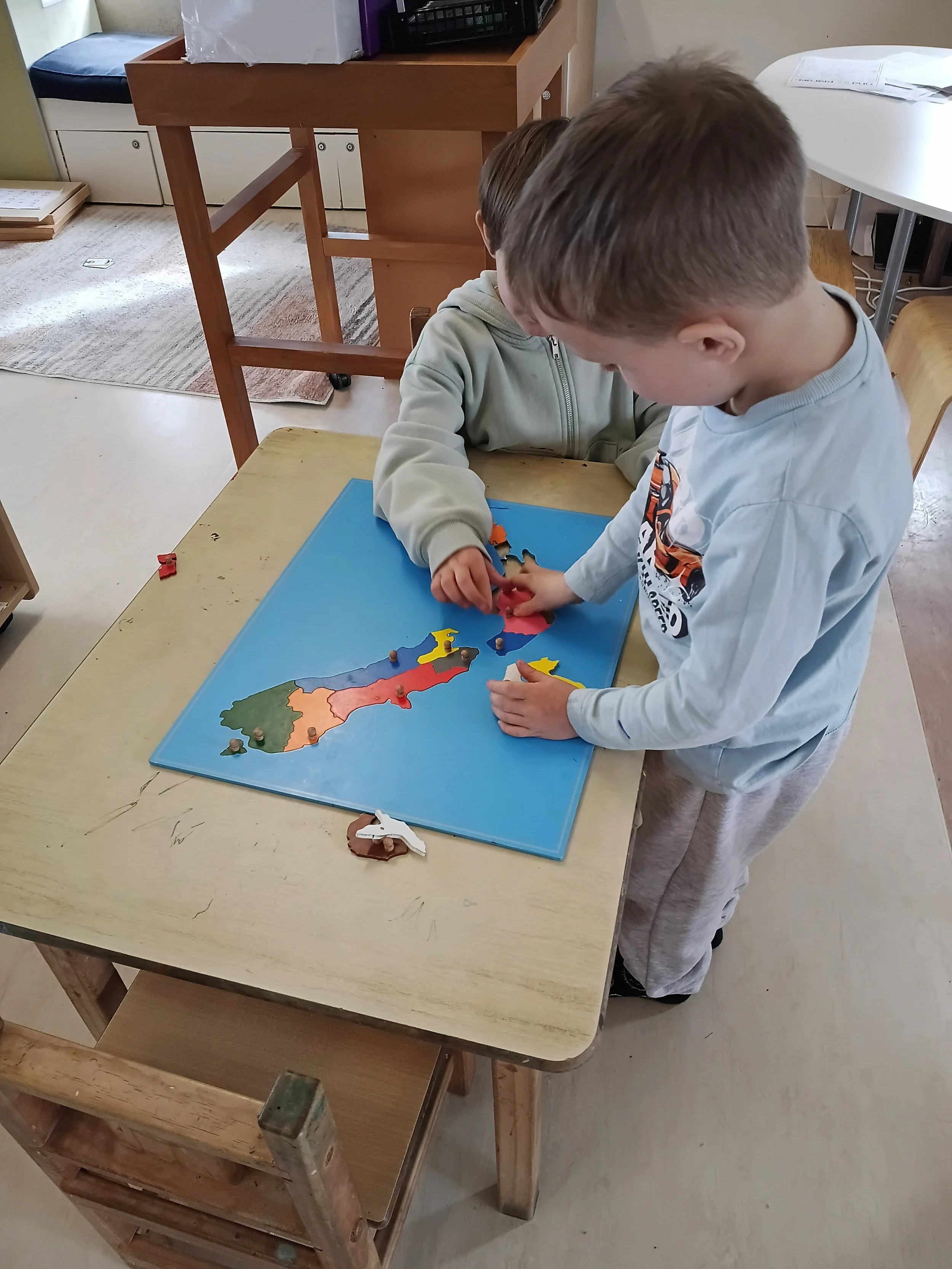
Genuine Montessori, wherever learning happens.
Our curriculum and educational principles remain consistent across our school programmes, even when the learning environment looks different.
Classroom Montessori
Children learn in our prepared mixed-age classroom, receiving lessons, using Montessori materials and working together as a community.
Hybrid Montessori
Children connect classroom learning with planned Montessori work at home. Families and teachers collaborate to support continuity and progress.
Distance Montessori
Our teacher guides a Montessori curriculum for learners across New Zealand. A supporting adult prepares the home environment and oversees daily learning.
The prepared environment matters everywhere.
In our classroom, the prepared environment includes materials, routines, relationships, spaces for concentration and opportunities for independence.
For distance and hybrid families, that preparation extends into the home.
Montessori learning is active, practical and relational. It involves much more than working through online worksheets or watching videos.
Curiosity becomes knowledge through work.
A glimpse of purposeful learning and discovery within our school.

A strong education, explained clearly.
We understand that choosing a different educational approach raises important questions.
Do children still learn reading, writing and maths?
Absolutely. These are essential academic foundations. Children receive direct lessons, practise skills and work towards individual academic goals.
Montessori materials help children develop understanding, while teachers guide progress towards increasing fluency and independence.
Is Montessori learning academically rigorous?
Yes. Montessori education includes a substantial academic curriculum across language, mathematics, science, history, geography and the arts.
We expect meaningful engagement, practice, effort and progress. We also encourage deeper investigation, independent reasoning and connections between subjects.
Do children choose whatever they want to learn?
Children make meaningful choices within the prepared environment.
Teachers introduce lessons, observe progress and guide children towards appropriate academic work. Freedom operates within clear educational and community expectations.
How does the Montessori curriculum build over time?
Children revisit important concepts through Montessori materials, lessons and the recurring Great Stories.
As their knowledge, reasoning and developmental capacities grow, they explore familiar ideas at greater depth and make new connections.
How does Montessori compare with the refreshed NZ Curriculum?
The refreshed NZ Curriculum specifies subject content and nationally sequenced learning expectations.
Montessori organises learning around developmental stages, a prepared environment, concrete materials, individual lessons and Cosmic Education.
Children still develop essential academic knowledge and skills, but their daily learning experience and the connections between subjects can look quite different.
Can Montessori children transition to secondary school?
Yes. Montessori primary students around the world move into secondary schools with different structures and teaching approaches.
We aim to develop strong academic foundations, independence, concentration, organisation, collaboration and adaptability to support children's next stage of learning.
Each transition is individual, and we encourage thoughtful planning with whānau.
Does my child need to have attended Montessori preschool?
No. We welcome families new to Montessori.
We introduce children to our learning materials, classroom routines and responsibilities, and provide parent education to help whānau understand the approach.
How can I understand my child's progress without grades and rewards?
Montessori teachers observe children's work, introduce lessons, monitor progress and set learning goals.
We focus on the development of actual knowledge, understanding and skills rather than using prizes or certificates as the main motivation.
Whānau can discuss progress, next steps and academic learning with the teacher.
Does this way of learning resonate with your whānau?
At Porirua Montessori, we believe children deserve a rich education that develops knowledge, imagination, independence and responsibility.
We welcome families who value this philosophy and want to learn and contribute alongside our school community.
You don't need previous Montessori experience. Start with curiosity, explore our approach and get in touch to begin a conversation.
Ask Us About Our Curriculum Is Montessori Right for Our Whānau?Porirua Montessori · 39 Cleat Street, Whitby, Porirua · Years 1–8